biofeedback in silicon valley, ca.
Your nervous system is the foundation. Biofeedback is how we stabilize it.

Biofeedback measures what your body is doing in real time — heart rate variability, muscle tension, skin conductance, peripheral temperature, and respiration — and displays it back to you as data you can actually see. Not a vague sense of how you're feeling, but a precise, moment-to-moment picture of your physiological state.
That visibility changes things. When you can see your nervous system's activity, you can begin to influence it — not by thinking your way through it, but through direct physiological experience.
biofeedback

my approach:
Biofeedback, in my practice, is about building capacity — not simply inducing calm.
Many of us have learned to manage by overfocusing on, or disconnecting from, the signals our bodies send. Biofeedback offers a third option: noticing without reacting. Over time, that noticing becomes more accurate, appraisals of internal experience begin to shift, and the stability built in session starts to generalize into daily life.
I offer biofeedback as a standalone service and as an integral part of the broader work we do together. When combined with neurofeedback or psychotherapy, the effects are often synergistic — each modality supporting and deepening the other.
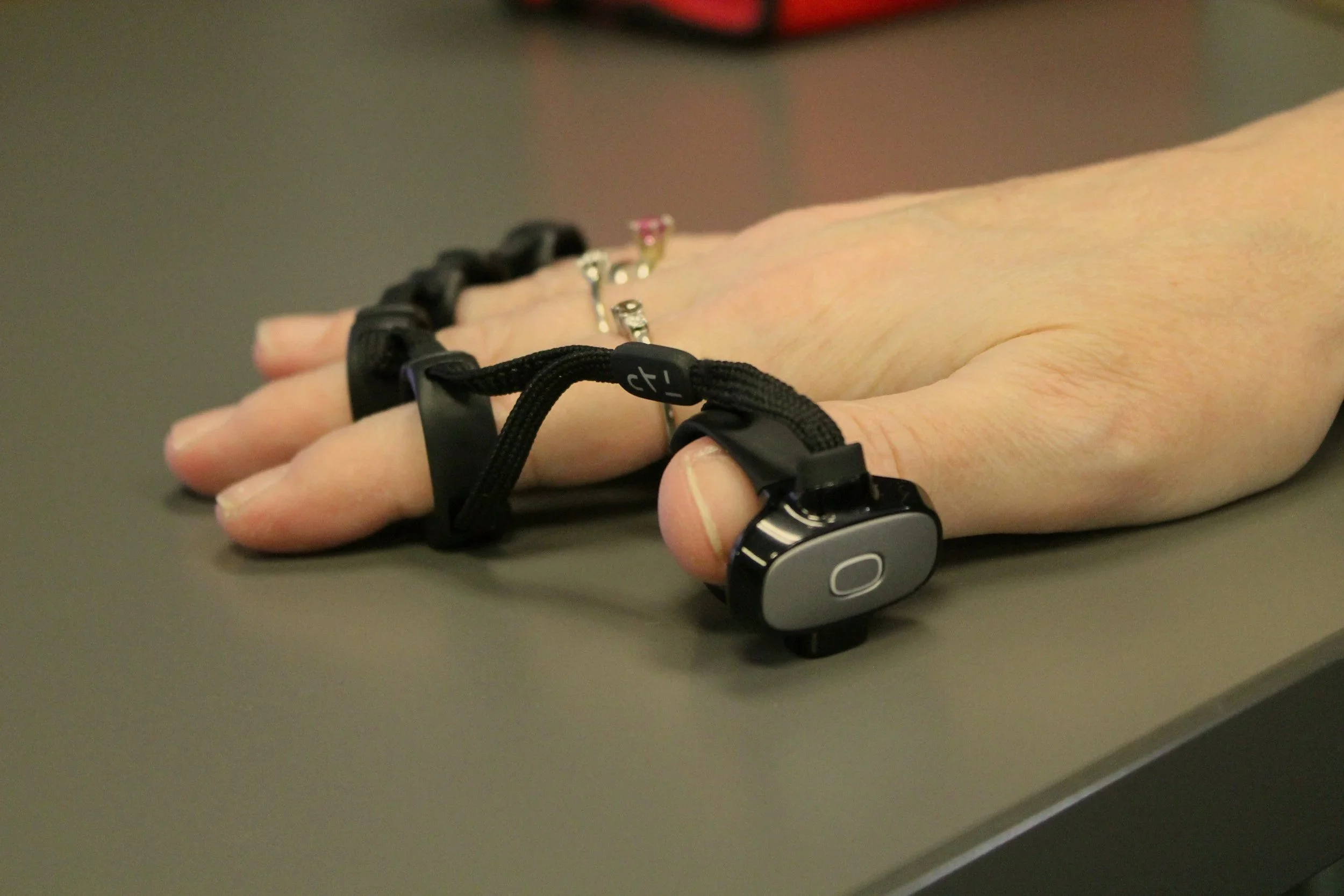
Modalities I use:
→ Heart rate variability (HRV)
→ Respiration rate and mechanics
→ Surface electromyography (sEMG) — muscle tension
→ Skin conductance (electrodermal activity)
→ Peripheral temperature

what biofeedback can help with:
Biofeedback is particularly well-suited for presentations where the body is carrying what words alone haven't been able to resolve.
→ Anxiety — generalized, panic, social
→ Trauma & PTSD, including complex PTSD
→ Chronic stress
→ Sleep difficulties
→ Chronic pain, tension headaches, migraines
→ Irritable bowel syndrome and other stress-related physical symptoms
→ Somatic symptom disorders
→ Autonomic dysregulation
→ Performance and burnout
FAQs
COMMON QUESTIONS
-
Not entirely. While it doesn't require cognitive effort or talking through difficult material, it does ask for your attention — a quality of engaged, relaxed noticing. The data responds to your state, and learning to read that relationship is itself part of the work.
-
It depends on what you're working on and how biofeedback fits into your broader treatment. For some, particularly those with complex or chronic presentations, it becomes a longer-term part of our work together.
-
Yes. There is substantial research supporting biofeedback — particularly HRV biofeedback — for anxiety, stress-related conditions, and a range of physiological presentations.
-
Not necessarily. Some clients come specifically for biofeedback on the recommendation of their physician or therapist, and we work together as part of a broader treatment collaboration — without biofeedback being embedded in ongoing psychotherapy with me.
-
As part of the intake process, I conduct a psychophysiological stress profile — a structured assessment that measures how your autonomic nervous system responds to and recovers from stress. The findings give us both a clearer, more objective picture of what's happening beneath the surface. Rather than a formal written report, we use the results as a foundation for conversation — exploring what the data means in the context of your life and using it to inform the direction of our work together.